


Blog
Why Choose a Mini Wind Turbine for Your Home?
Why Choose a Mini Windturbine for Your Home?
A Mini Windturbine can turn ordinary wind into useful household electricity. However, performance depends heavily on location, tower height, and local wind patterns. The U.S. Department of Energy’s Distributed Wind Market Report 2023 recorded more than 1,100 megawatts of distributed wind capacity in the United States through 2022. This figure includes residential, agricultural, commercial, and community installations. It shows practical adoption, but it does not guarantee savings for every household.
The details matter. A turbine beside a quiet field may produce steady power. A rooftop unit surrounded by trees may mostly capture turbulence. At ten metres, nearby buildings can create uneven airflow, vibration, and disappointing output. A professional site assessment should examine annual wind speed, tower clearance, electrical demand, and maintenance access. IEC 61400-2 provides international safety and design guidance for small wind turbines. These standards support safer product selection and more credible performance comparisons.
Global context is also encouraging. The Global Wind Energy Council reported 117 gigawatts of new wind capacity worldwide in 2023, raising total installed capacity above one terawatt. Large wind farms dominate that figure, not home systems. That distinction is easy to miss. A Mini Windturbine is usually a supplement, not a complete replacement for grid electricity. It may reduce daytime purchases, support batteries, or power remote equipment. Results can be modest. They can still be valuable where wind is consistent and grid access is expensive. Careful calculation beats attractive promises.
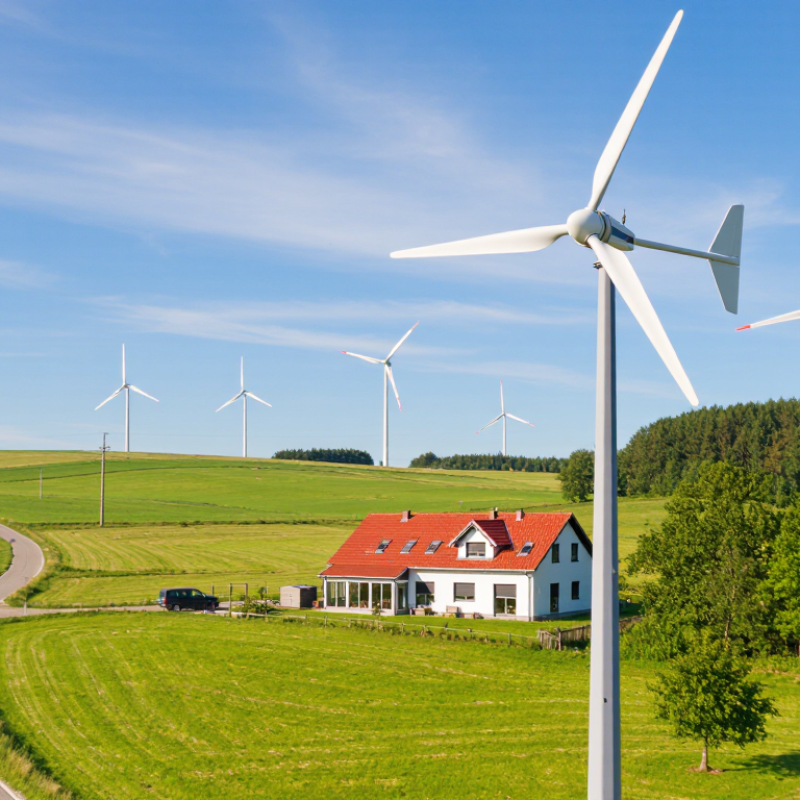
Table of Contents
[Hide]
What Is a Mini Wind Turbine and How Does It Work?
Why Choose a Mini Wind Turbine for Your Home?
A mini wind turbine is a compact machine that converts moving air into electricity. Wind pushes the blades, causing a rotor to spin around a central shaft. That rotation drives a generator, which produces electrical power. A controller manages the output, while an inverter changes it into household-use electricity. Some systems also store energy in batteries.
Small turbines usually use horizontal or vertical blades. Horizontal models often capture stronger wind, but they need careful alignment. Vertical models can accept wind from different directions. Neither design works equally well everywhere. At a rural home with steady wind, a turbine may support lighting, monitoring equipment, or other modest loads. On a roof, turbulence from trees and nearby buildings can reduce performance sharply.
Practical assessment matters more than appearance. Measure wind conditions at the proposed height, and check local installation rules before buying equipment. Towers usually outperform roof mounts because they reach cleaner airflow. I have seen homeowners expect constant power from compact turbines, then feel disappointed during calm weeks. That expectation needs correction. Wind output changes hourly, seasonally, and even within a few meters. Maintenance also matters. Inspect blades, wiring, fasteners, and noise levels regularly. A reliable installation uses certified electrical components and professional guidance when structural or grid connections are involved.
Why Choose a Mini Wind Turbine for Your Home?
What Is a Mini Wind Turbine and How Does It Work?
What Is a Mini Wind Turbine and How Does It Work?
| Data Dimension | Typical Information | What It Means for a Homeowner |
|---|---|---|
| Definition | A small wind turbine is a wind-powered generator generally used for homes, farms, remote buildings, boats, or small community systems. | It can produce electricity on-site instead of relying entirely on electricity from the grid or a fuel generator. |
| Common Rated Power Range | Approximately 100 watts to 10 kilowatts for small-scale applications. | The appropriate size depends on household demand, local wind conditions, tower height, available space, and whether the system is grid-connected or off-grid. |
| Typical Rotor Diameter | About 1 to 7 meters, depending on rated power and turbine design. | A larger rotor generally captures more wind energy, but it also requires more structural support, clearance, and installation space. |
| Main Operating Principle | Wind pushes the blades, the rotor turns a generator, and the generator converts mechanical rotation into electrical energy. | The system generates electricity without burning fuel while the wind speed remains within its operating range. |
| Energy Conversion Path | Wind energy → blade rotation → generator output → controller or inverter → battery, household loads, or utility grid. | The controller manages charging and protection, while an inverter converts electricity into the form required by household appliances or the grid. |
| Typical Cut-In Wind Speed | Approximately 2.5 to 4 m/s, depending on the turbine design. | Below this speed, the turbine may rotate slowly but usually produces little or no useful electricity. |
| Typical Rated Wind Speed | Approximately 9 to 12 m/s for many small wind turbines. | This is the wind speed at which the turbine can reach its stated rated power under specified test conditions. |
| Typical Cut-Out Wind Speed | Approximately 20 to 25 m/s for many designs. | The turbine may shut down or apply braking protection during very strong winds to reduce mechanical and electrical stress. |
| Recommended Tower Consideration | The rotor should be positioned well above nearby turbulence sources; a commonly used planning rule is to place it at least 9 meters above nearby obstacles within roughly 150 meters. | Trees, buildings, and ridgelines can create turbulence that reduces output and increases fatigue on the turbine. |
| Annual Capacity Factor | Roughly 5% to 25% for many small wind installations, with strong dependence on the site. | Rated power is not continuous power. A turbine rated at 1 kW will usually produce much less than 1 kW on average over a full year. |
| Illustrative Annual Energy: 400 W Unit | About 175 to 875 kWh per year at a 5% to 25% capacity factor. | This estimate may cover selected lighting, electronics, communications equipment, or other modest loads, but actual production depends on the wind resource. |
| Illustrative Annual Energy: 1 kW Unit | About 438 to 2,190 kWh per year at a 5% to 25% capacity factor. | This can make a meaningful contribution to household electricity use in a suitable windy location, but it may not supply all annual demand. |
| Illustrative Annual Energy: 3 kW Unit | About 1,314 to 6,570 kWh per year at a 5% to 25% capacity factor. | A larger system may support a greater share of household loads, provided the site has sufficient wind and the structure can safely support the turbine. |
| Space Requirement | The turbine itself has a relatively small footprint, but the tower requires clear airspace, access, setbacks, and a suitable foundation. | A rural or open site is generally more suitable than a dense urban area with buildings and turbulent airflow. |
| Grid-Connected Configuration | Uses a compatible inverter and electrical protection equipment to supply household loads and, where permitted, export excess power. | Local utility approval, interconnection rules, metering requirements, and electrical inspections may apply. |
| Off-Grid Configuration | Usually combines the turbine with a charge controller, batteries, an inverter, and sometimes solar panels or a backup generator. | Storage and backup generation help maintain power when wind production is low or household demand is high. |
| Potential Advantages | Can generate power day and night, uses a renewable resource, complements solar in some locations, and may reduce fuel use. | Wind generation can be especially useful where nighttime or winter winds are stronger and solar production is limited. |
| Important Limitations | Output varies with wind speed; installation may require permits, structural engineering, maintenance access, and adequate separation from obstacles. | A professional site assessment is important because a high average wind speed at ground level cannot be assumed from regional weather data alone. |
| Basic Maintenance | Periodic inspection of blades, fasteners, bearings, electrical connections, braking systems, tower hardware, and corrosion protection. | Regular maintenance helps identify wear, vibration, cable damage, or storm-related problems before they become safety issues. |
| Best Site Profile | An open, unobstructed location with consistent wind, adequate tower height, safe setbacks, and applicable permits. | The quality of the site usually has a greater effect on annual energy production than the turbine’s nameplate rating alone. |
Note: Annual energy examples are calculated as rated power × 8,760 hours × capacity factor. They are illustrative estimates, not guaranteed production figures. Actual results depend on measured wind speed, wind distribution, air density, turbulence, tower height, system losses, maintenance, and local regulations.
Related Posts
-
2026 Top DIY Wind Turbine Types for Global Buyers?
-
How to Choose a Mini Wind Turbine for Your Home?
-

What Is the Best Home Wind Turbine System from China?
-
What is a Mini Windturbine and How Does it Work for Sustainable Energy
-

How to Purchase Mini Windturbines for Your Business?
-

Top 10 Mini Wind Turbine Manufacturers from China at the 137th Canton Fair
Tell us about your project
Our Off-grid experts will come back with recommendations